
Agentic Signal
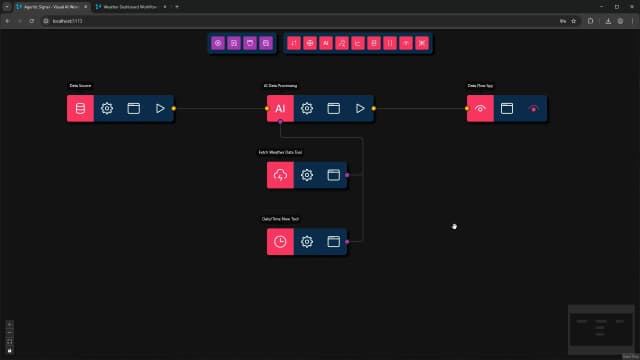
Agentic Signal is a cutting-edge platform designed to empower users to build AI workflows visually with an emphasis on privacy and local execution. It enables developers, data scientists, and AI enthusiasts to create complex, extensible automation pipelines without relying on cloud services, ensuring that all data and processes remain fully local and secure. The platform supports a modular node ecosystem, allowing users to integrate various AI models, data sources, and custom logic into seamless workflows. By providing a visual interface for workflow construction, Agentic Signal lowers the barrier to entry for AI automation, making it accessible to a broader audience. Its architecture supports extensibility and customization, enabling users to tailor AI-driven solutions to their specific needs. With a focus on privacy, local intelligence, and ease of use, Agentic Signal is ideal for organizations and individuals seeking to harness AI capabilities while maintaining full control over their data and infrastructure.
Share your honest experience with Agentic Signal

Konsta UI
Konsta UI is a comprehensive library of mobile UI components designed specifically for Tailwind CSS. It provides developers with a rich set of ready-to-use, customizable components that enable rapid development of mobile applications with a consistent and modern design. Konsta UI supports multiple frameworks including React, Vue, and Svelte, making it versatile for various development environments. The components are optimized for mobile experiences, featuring iOS and Material Design styles, which help developers build native-like user interfaces efficiently. By leveraging Tailwind CSS utility classes, Konsta UI ensures that the components are highly customizable and easy to integrate into existing projects. This UI kit is ideal for developers looking to accelerate their mobile app development process while maintaining high design standards and responsiveness.

AGINT
AGINT is an innovative open-source interface layer designed to empower Large Language Models (LLMs) with the ability to control your computer directly and safely. It enables AI to interact with your operating system by manipulating the mouse, keyboard, filesystem, browser, and applications, all while maintaining transparency through auditable logs and permission controls. AGINT prioritizes security by incorporating human-in-the-loop oversight, ensuring that AI actions are monitored and controlled by users. This platform is ideal for developers, researchers, and teams looking to integrate AI-driven automation and control into their workflows. With a focus on cross-platform compatibility and an MIT license, AGINT fosters an open and collaborative environment for hackers and teams to innovate. Early prototypes and demos are available on GitHub, showcasing its potential to revolutionize how AI interfaces with computing environments, making AI a practical and powerful assistant for everyday computer tasks.

Polyglot STEM Buddy
Polyglot STEM Buddy is an open-source educational web application designed to simplify STEM learning for users of all ages by providing multilingual support. It aims to make science, technology, engineering, and mathematics accessible to a diverse global audience by offering content in multiple languages, breaking down language barriers in education. The platform features an intuitive interface where users can select their age group and preferred language, ensuring a personalized and inclusive learning experience. By combining interactive STEM content with language accessibility, Polyglot STEM Buddy empowers learners worldwide to engage with complex subjects in a way that suits their linguistic and developmental needs. Its focus on ease of use and broad accessibility makes it an ideal tool for educators, students, and self-learners seeking to enhance their STEM knowledge across different languages and cultures.

Puck
Puck is an open-source visual editor designed specifically for React applications. It empowers developers to seamlessly integrate powerful visual editing capabilities into their own React projects, enabling the creation of intuitive and dynamic content editing experiences. By leveraging Puck, teams can build next-generation content tools that simplify the process of managing and customizing UI components without sacrificing developer control or flexibility. The editor supports a highly customizable and extensible architecture, making it ideal for a wide range of use cases, from content management systems to complex web applications. Puck’s open-source nature encourages community collaboration and continuous improvement, ensuring it evolves alongside the React ecosystem. Its focus on developer experience and user-friendly interfaces helps bridge the gap between design and development, accelerating workflows and enhancing productivity. Overall, Puck serves as a robust foundation for building sophisticated visual editing solutions that integrate deeply with React’s component model.

VSCode Extensions Hub
VSCode Extensions Hub is a centralized platform designed to help developers discover, explore, and manage powerful extension packs for Visual Studio Code. It serves as a curated collection of extension bundles that enhance productivity, streamline coding workflows, and add valuable features to the VSCode environment. By aggregating various extension packs, the Hub simplifies the process of finding compatible and useful tools tailored to different development needs, whether for web development, debugging, or language support. The platform offers an intuitive interface with search and category filters, making it easy to browse and select extensions that match specific project requirements. VSCode Extensions Hub is ideal for developers looking to optimize their coding experience by leveraging community-driven and expertly curated extensions, ultimately boosting efficiency and coding quality within the popular VSCode editor.

Kelma
Kelma is an open-source, drop-in comment section provider designed for every website. It offers an ad-free and privacy-respecting platform that ensures minimal telemetry collection and never sells user data. Kelma is built for speed, delivering an incredibly snappy user experience where comments load instantly and interactions feel smooth. The solution is fully transparent and auditable, allowing users to choose between hosted or self-hosted deployments. Kelma supports effortless setup with easy customization, offering 35 themes to seamlessly integrate with any website design. It also supports multiple languages, making it accessible globally. Pricing is fair and usage-based, with no tiers, plans, hidden fees, or monthly subscriptions, allowing users to pay only for what they use. Overall, Kelma provides a modern, privacy-conscious, and highly customizable comment system that enhances user engagement without compromising performance or user data privacy.